Premise
Oleguer descends.
The stone remembers.
Autumn 1987. Oleguer Parkinson, archivist at the Universitat Rovira i Virgili, receives authorization to document an unmapped section beneath Tarragona’s Early Christian necropolis. Museum expansion works have uncovered an access sealed since the 18th century.
What should be a four-day archaeological inventory becomes something else when his field recorder, a reel-to-reel Nagra model, registers impossible sounds 30 meters beneath the surface: a Latin litany, the rhythmic strike of metal against stone, and a breath that is not his own.
Oleguer descends through layers of history. Sixth-century Visigothic crypts lean on Roman funerary galleries that connect with the Imperial Tarraco complex. But beneath those, there are older cavities: Iberian excavations with pre-linguistic marks that match no known record.
The necropolis’s limestone contains more than remains. It has recorded the frequencies of everything that happened within its walls. And in total darkness, those echoes sound more present than Oleguer’s own footsteps.
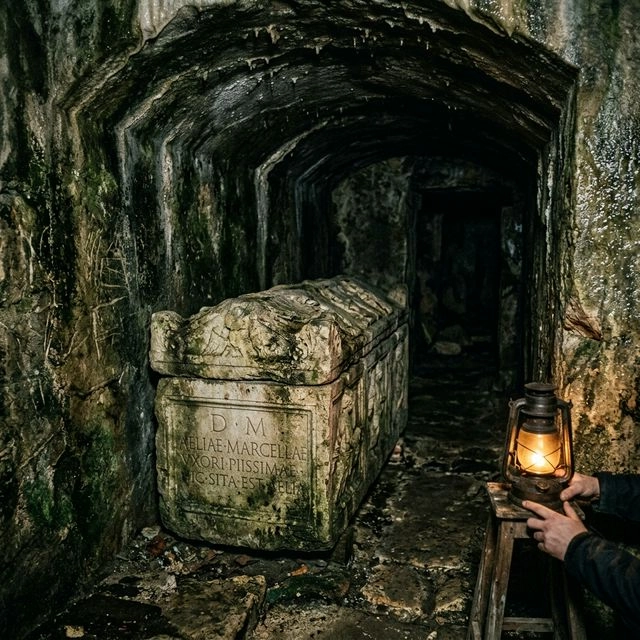
VISUAL_RECORD_04: Sarcophagus with D·M inscription, level -2, east gallery.
Mechanics
What Oleguer carries. What the stone whispers back.
Hearing-guided exploration
In absolute darkness, Oleguer relies on acoustics. The audio engine recalculates in real-time how sound bounces, absorbs, and shapes itself according to the geometry of each gallery, its material, and humidity.
A long hallway returns a delayed echo. A wide chamber scatters it. A nearby wall crushes it. And occasionally, the reverberation includes frequencies you didn’t generate.
Field notebook and compass
There are no minimaps or HUDs. You carry graph paper, a declination compass, chalk for marking walls, and an analog pedometer. Your map is only as good as your ability to interpret distances and angles in pitch black.
A 15-degree error at an intersection could mean mapping an entire passageway in the wrong direction. And there’s no way to know until you try to head back.
Darkness as the antagonist
There is no visible sanity meter. What exists is a perceptual degradation system tied to time spent in darkness, acoustic stress, and isolation. Post-processing shaders respond subtly: edges blur, distances lie, silhouettes suggest presences.
It’s not that something is there. It’s that your perception is no longer reliable. And that’s worse.
1987 analog equipment
Heavy flashlight with limited batteries. Nagra recorder with finite tapes. A Zippo lighter as a last-resort light. Every object has physical weight and generates sound when handled: sound the necropolis absorbs and returns distorted.
Resource management is not a minigame. It is the line between documenting ruins and becoming part of them.